The Three-Piece Formula That Works Every Cold Morning
Quick Answer: The formula is one fitted layer, one relaxed layer, and one long layer - in that order, in a tonal colour family, finished with a single defined shoe. It works because the fitted piece keeps the silhouette controlled, the relaxed piece provides warmth and texture, and the long piece creates the vertical line that makes any combination look deliberate. Build three of these and getting dressed becomes a two-decision process.
The reason mornings are hard is not a lack of clothes. It is that a variable-temperature day requires a decision, and 7am is a bad time for decisions.
What are the three pieces?
A structure rather than specific garments, which is why it survives changes in what is in your wardrobe.
Piece 1: fitted. Against the body, thin, and simple. A fine knit, a long-sleeve top, a bodysuit, a fitted shirt. This layer’s job is to define the silhouette so everything over it can be loose without the whole outfit losing shape.
Piece 2: relaxed. Volume and texture. An oversized knit, a flannel shirt worn open, a knit gilet, a soft cardigan. This is where the warmth lives, and it is the layer that comes off when the afternoon arrives.
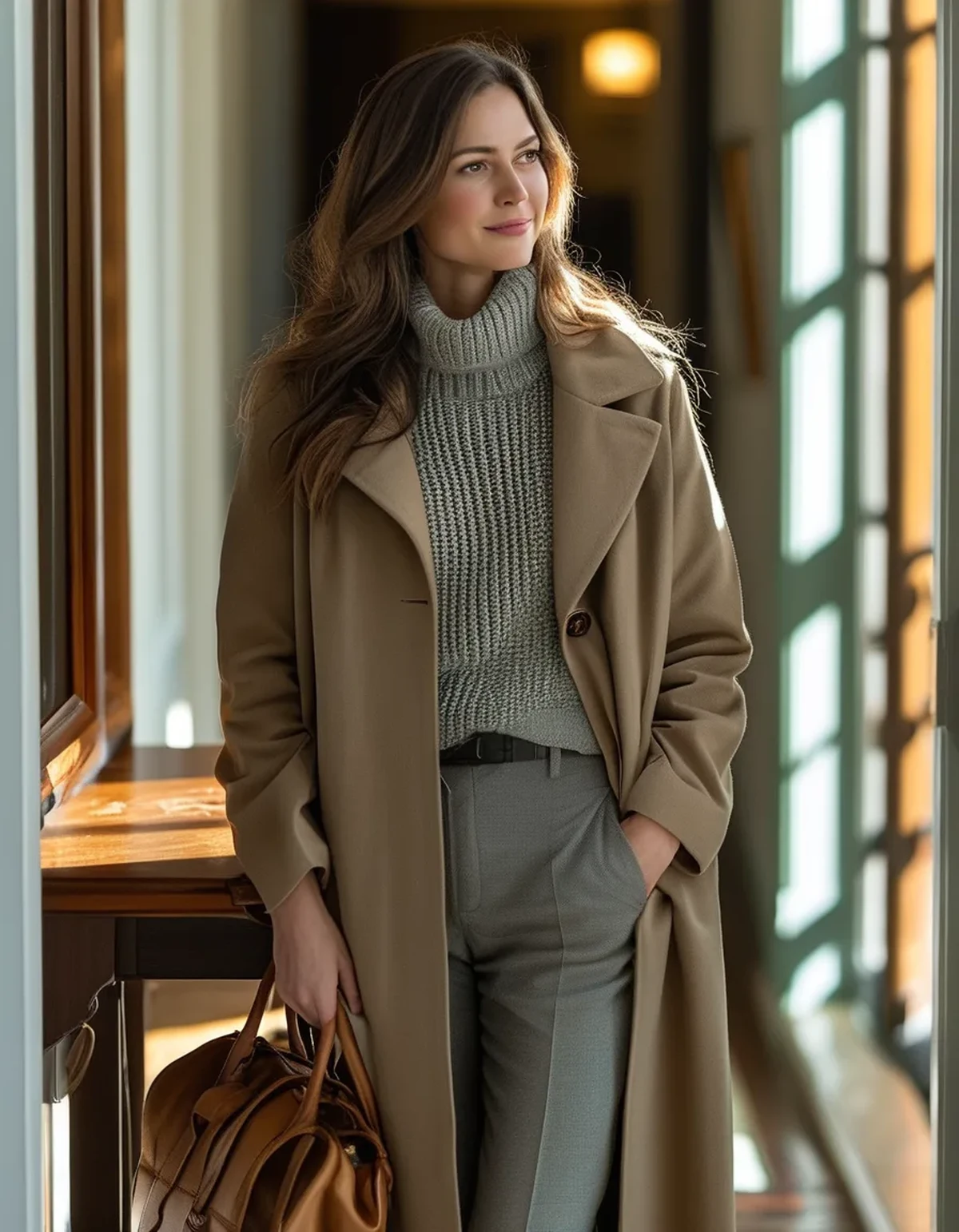
Piece 3: long. A coat, a long cardigan, a duster, a long blazer. This creates the vertical line, which is what makes the whole thing read as an outfit rather than as clothes put on in sequence.
Plus two finishing decisions:
- One defined shoe. A boot, a loafer, a clean trainer. Not a shoe you are ambivalent about - the shoe anchors the register of the whole outfit.
- One point of interest. A bag, a scarf, a piece of jewellery, or a colour. One is enough.
The bottom half is deliberately unspecified, because the formula works with trousers, jeans, a skirt with tights, or leggings. The layering above is what determines whether it works, which is why most people’s problem is the top half.
Why does this particular structure work?
Because it solves the three things that go wrong with transitional outfits simultaneously.
Problem 1: temperature range. A 10-degree swing between morning and afternoon cannot be handled by one garment. Three layers means two of them can come off, and the fitted base is wearable on its own.
Problem 2: proportion. Layering for warmth adds bulk, and bulk without structure reads as shapeless. A fitted base means the volume above it has something to contrast against, so the outfit reads as deliberately relaxed rather than as several jumpers.
Problem 3: the vertical line. An outfit made of three horizontal blocks - top, jumper, trousers - visually cuts you into segments. A long third layer runs uninterrupted from shoulder to below the hip, which is why a long coat makes almost any combination underneath look better.
The tonal colour rule is what does the rest. Keeping the three layers within one colour family - all warm neutrals, all greys, all navy-and-cream - means the layers read as one garment rather than three. This is the single change that most reliably makes an outfit look expensive, and it requires no new clothes.
Contrast belongs in the texture, not in the colour: a fine knit against a chunky knit against a smooth wool coat, all in oatmeal, looks considered. The same three in three different colours looks assembled.

How do you build three of these?
By auditing what you already own against the structure rather than shopping for it.
Lay out everything in three piles - fitted, relaxed, long - and see where the gaps are. Most wardrobes are heavy on the first pile and thin on the third, which is why outfits feel unfinished.
Build three combinations and write them down. Actually write them down, or photograph them. The formula only saves time if you do not have to reconstruct it each morning.
A worked example, tonal warm neutrals:
- Fitted: cream fine-knit long sleeve
- Relaxed: oatmeal oversized cardigan
- Long: camel wool coat
- Bottom: chocolate wide-leg trousers
- Shoe: brown ankle boot
- Interest: a gold chain
A second, cooler and sharper:
- Fitted: black bodysuit or fine knit
- Relaxed: grey flannel overshirt, worn open
- Long: charcoal longline blazer
- Bottom: dark straight jeans
- Shoe: black loafer with a visible ribbed sock
- Interest: a bright scarf
A third, softest:
- Fitted: navy long-sleeve top
- Relaxed: navy knit gilet
- Long: navy or grey duster cardigan
- Bottom: grey trousers
- Shoe: white trainer
- Interest: a structured bag
If there is a gap, it is almost always the long layer. One good long coat or duster in a neutral does more for a transitional wardrobe than three new tops.
What Nobody Tells You About Outfit Formulas
The formula is for the days you do not want to think, not for every day. It is a floor, not a ceiling. Having three reliable combinations does not stop you dressing creatively - it means the days when you have no capacity for it still work.
Writing it down is the part that works, and the part everyone skips. A formula you have to reconstruct mentally at 7am is not saving you anything. A photo in your phone of three complete outfits is the actual product, and it takes half an hour once.
The long layer is the piece worth spending on. It is worn over everything, it is what people see, and it is the piece that carries the outfit. A good coat over cheap layers looks considerably better than the reverse.
Tonal does not mean matching exactly. Three shades of oatmeal that are slightly different look intentional; two pieces that are almost-but-not-quite the same shade of black can look like a mistake. Either commit to the same shade or make the difference obvious.
The shoe decides the register more than anything else. The same three layers with a trainer, a loafer, or a heeled boot produce three genuinely different outfits. This is the cheapest way to get more range out of the same clothes.
And the point of interest has to be singular. A statement bag, a bright scarf, and large earrings together compete with each other, and the eye has nowhere to settle. One, deliberately chosen, does more than three - which is the part that most people find hardest to accept about the whole system.
FAQ: The Three-Piece Formula, Answered
Does this work if I do not own a long coat?
A long cardigan or a duster works identically and is often warmer indoors. The length is what matters, not whether it is outerwear.
What about warmer days?
Drop the relaxed layer and keep the fitted piece with the long one. Two of the three still reads as a complete outfit, which is part of why the structure works across a swing.
Can I use this with a skirt or a dress?
Yes. A fitted knit over a slip dress, an oversized cardigan, and a long coat is the same formula. A dress can replace the fitted layer and the bottom half together.
How do I stop three layers looking bulky?
Keep the base genuinely thin, and make sure the long layer is not fighting the middle one for volume. If both the second and third layers are chunky, the outfit will look bulky no matter what.
Is tonal dressing boring?
It can be, if the textures are all the same too. The interest comes from contrast in texture - smooth against ribbed against brushed - within one colour family.
TL;DR:
- Fitted, relaxed, long - in that order, in one colour family, with one defined shoe
- The fitted base controls the silhouette so the volume above it reads as deliberate
- A long third layer creates the vertical line that makes any combination look finished
- Build three complete versions and photograph them; the formula only works if it is written down
- Contrast in texture, not in colour, and keep the point of interest to one
The hardest mornings of the year are the ones where it is 9°C at eight and 21°C at two. A structure you can execute without deciding anything is worth more on those days than any individual garment - and the whole thing takes half an hour to set up once.
Keep Reading
This article is for general informational purposes only and is not medical advice. It is not a substitute for professional diagnosis or treatment. Always consult a qualified healthcare provider about your individual situation, especially before making significant changes to your diet or exercise routine.