The Outer Layer Decides Whether Your Athleisure Reads as Clothes
Quick Answer: People read an outfit from the outside in, and the outermost layer sets the category before anything underneath registers. A structured jacket in a non-technical fabric makes leggings read as trousers; a soft technical zip-up makes the same leggings read as gym kit. Change the jacket and you change the whole outfit without touching anything else.
You have the good leggings, the matte ones in the right weight. You have a decent top. And it still looks like you are going to the gym.
Look at the jacket.
Why does the outer layer carry so much of the read?
Because of what people actually see, in what order.
When someone takes in an outfit, they register the overall silhouette first, then the outermost surfaces, then details. The outer layer is most of the silhouette and nearly all of the visible surface area, so it disproportionately determines what category the whole thing falls into.
There is a second reason, which is that outerwear is where the technical signals live. Activewear is identifiable by a handful of specific cues, and almost all of them are more visible on a jacket than on a legging:
- Sheen. Technical fabrics reflect light differently from wovens. A slightly shiny surface is one of the fastest activewear signals there is.
- Elastic hems and cuffs. A gathered elastic hem at the wrist and waist is unambiguously sportswear.
- Contrast zips and reflective detailing. Functional, and functional is what makes it read as kit.
- A soft, unstructured shoulder. Sportswear jackets have no shoulder construction. Tailoring does.
The leggings underneath carry almost none of these cues if they are matte and the right weight. So the jacket is where the read is decided, and it is where most people are still wearing the thing that came with the workout.
What makes a jacket work over athleisure?
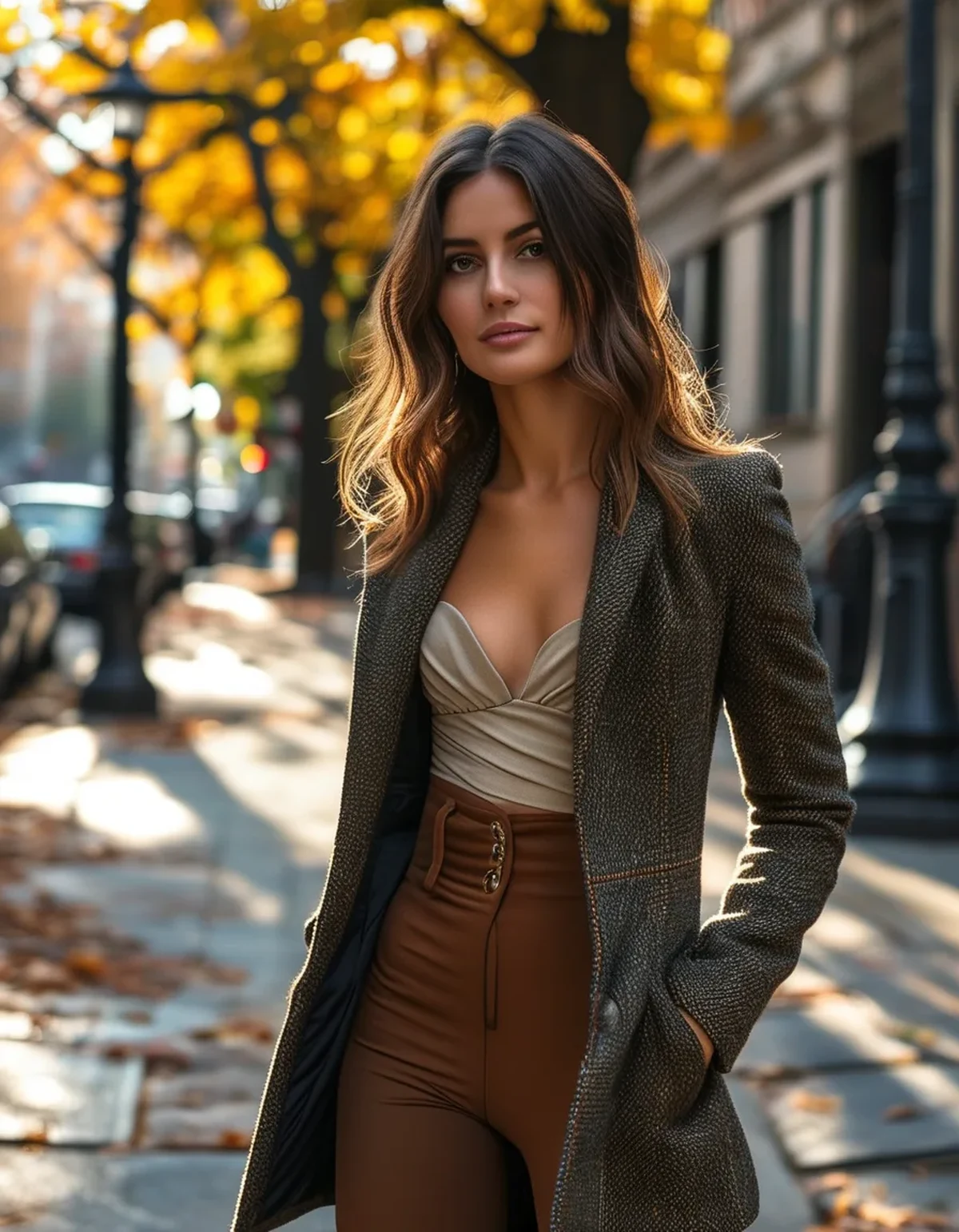
Structure at the shoulder, a woven fabric, and a hem that does not gather. Three properties, and you need at least two.
Structure at the shoulder is the single biggest one. A defined shoulder line — a blazer, a well-cut overshirt, a trench, a denim jacket — creates a shape that reads as clothing. It does not need to be sharp tailoring; a soft-shouldered unlined blazer works fine.
A woven, matte fabric. Wool, cotton, denim, a matte technical fabric that does not look technical. What you are avoiding is sheen and the visual softness of jersey.
A straight hem. Elastic gathering at the hem reads as sportswear from a distance. A straight, unfinished, or lightly structured hem does not.
Options that work, roughly by formality:
- A relaxed blazer. The highest-return single item for this purpose. Over a bra top and leggings it converts the whole outfit.
- An overshirt or shirt jacket. Easier to wear than a blazer, nearly as effective, and better in genuinely cold weather.
- A denim jacket. Works with almost everything, though it is short, which matters below.
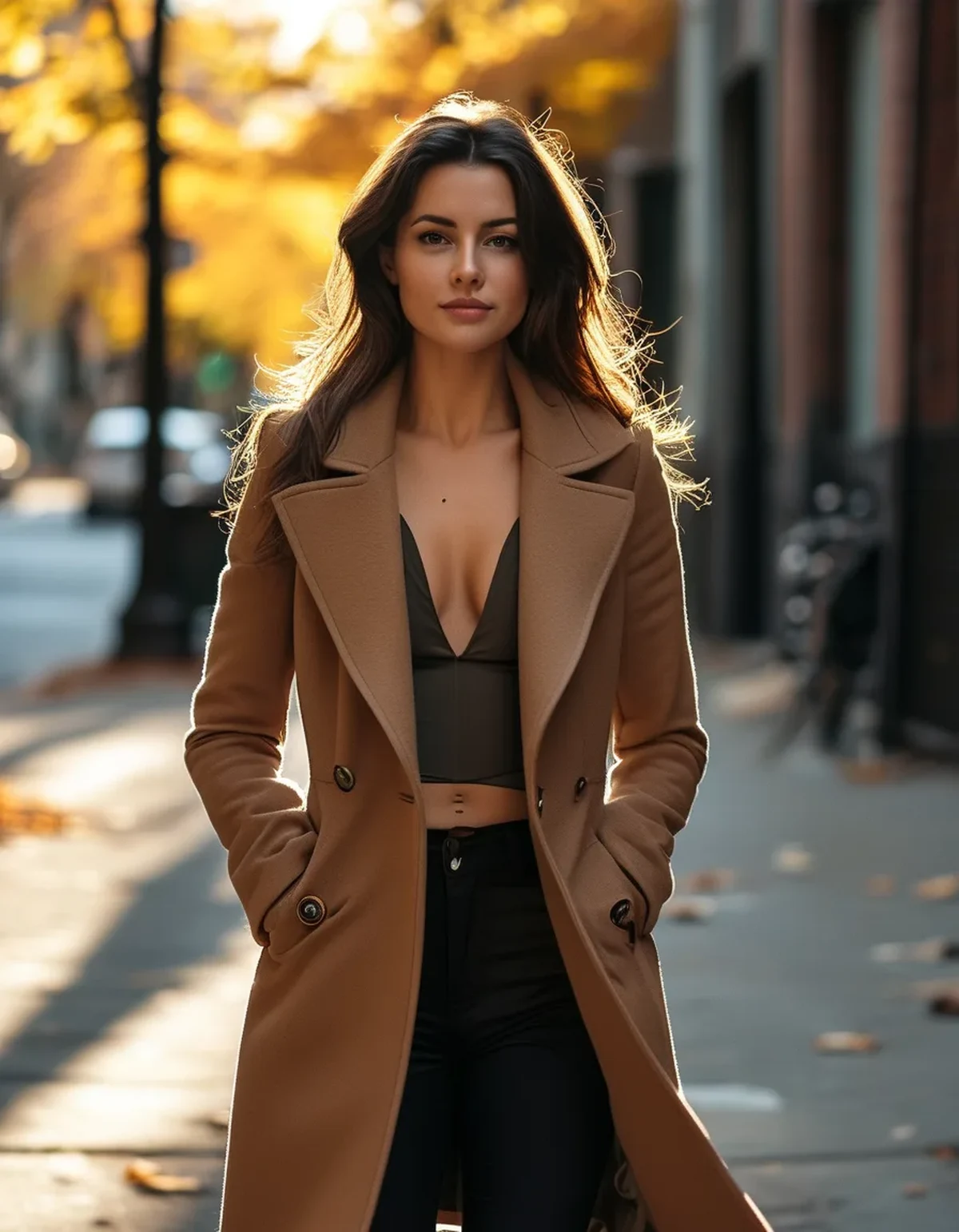
- A trench or a long wool coat. Excellent, and the length does additional work.
- A leather or leather-look jacket. Very effective, partly because it is so far from technical fabric.
One that does not work despite everyone trying: the soft technical zip-up in a slightly different colour from the leggings. It is comfortable and it is exactly the item creating the problem.
Does length change the answer?
Substantially, and it interacts with what you are wearing underneath.
A longer jacket — mid-thigh or below — does two things. It covers more of the legging, so proportionally less of the outfit is stretch fabric, and it creates a vertical line that reads as considered. A long coat over leggings and boots is close to foolproof and is why it is such a common autumn uniform.
A short jacket — cropped, or hitting at the waist — leaves the entire lower body visible, which means the leggings have to do more work on their own. This is fine if the leggings are matte, thick, and well-fitting, and it is exposed if they are not.
The rule that actually holds: the shorter the jacket, the better the leggings need to be. A cropped denim jacket demands more of what is underneath than a long wool coat does.
On proportion: the classic problem is a jacket that ends exactly at the widest point of the hip, which draws a horizontal line where you least want one. Either above the hip or below it — a couple of inches in either direction changes the whole silhouette.
One length worth knowing about: a jacket that hits at mid-thigh is the most versatile for this specific purpose. Long enough to change the proportion, short enough to not look like you are wearing a coat indoors.
Myth vs Fact: Making Athleisure Read as Clothes
Myth: Expensive leggings are what make athleisure look expensive. Fact: Fabric weight and matte finish matter, and beyond a fairly low threshold, price does not. The jacket, the shoes, and the bag are where visible quality registers. A mid-price legging under a good coat outperforms the reverse by a wide margin.
Myth: You need to hide the activewear. Fact: You need to mix categories, not conceal one. A visible bra top under an open blazer reads as a deliberate choice. The same bra top under a technical zip-up reads as gym kit, because both items are from the same category and nothing signals intent.
Myth: Matching sets are more polished. Fact: A matching set is the most legible activewear signal available, because matching technical pieces exist almost nowhere else. Sets look excellent with a contrasting non-technical outer layer and look like kit without one.
Myth: Trainers ruin it. Fact: Trainers are fine — running shoes are the problem. A clean leather or canvas sneaker is neutral. A performance running shoe with visible tech in the sole is a strong signal, and it is the item that most often undoes an otherwise good outfit. This is the swap with the biggest effect for the least effort.
Myth: This only works in cold weather when you can wear a coat. Fact: The principle holds in warm weather with a lighter outer layer — an open linen shirt, a light overshirt, a cotton blazer. The layer does not need to be warm; it needs to be woven and structured.
FAQ: Athleisure Layering Questions, Answered
What if I get too warm in a structured jacket?
Use an unlined one, and choose an overshirt rather than a blazer. Unlined cotton and linen blends are comfortable well into the twenties, and an overshirt worn open moves air freely. The structure comes from the cut and the fabric, not from weight.
Does colour matter?
Less than fabric, but it helps. A jacket in a colour that does not exist in your activewear — camel, chocolate, navy, cream — signals a different category immediately. Black over black is the hardest combination to make read as clothes, because there is no visual break at all.
Can a cardigan do the same job as a blazer?
A substantial one, yes — a heavy longline knit with some structure works well and is more comfortable. A thin draped cardigan does not, because it adds softness to an already soft outfit and creates no shape.
What is the single best purchase for this?
A mid-thigh, unlined, relaxed blazer in a matte woven fabric, in a colour that is not black. It works over leggings, over a bra top, over joggers, and over regular clothes, and it is the item people notice when someone seems to have solved this.
TL;DR:
- People read an outfit from the outside in. The outer layer sets the category before anything else registers.
- Look for shoulder structure, a woven matte fabric, and a straight hem. Avoid sheen, elastic cuffs, and contrast zips.
- The shorter the jacket, the better the leggings need to be. Long coats are close to foolproof.
- Avoid a hem that lands exactly at the widest point of the hip. Go a couple of inches either way.
- Swap performance running shoes for a clean leather or canvas sneaker. Biggest effect, least effort.
- Best single buy: a mid-thigh unlined relaxed blazer in a matte woven, not in black.
Change the jacket, not the leggings.
See It in Motion
Seen here: Super High Waist Embossed Yoga Leggings with Inner Pocket — shop it on bubblelime.com
Keep Reading
This article is for general informational purposes only and is not medical advice. It is not a substitute for professional diagnosis or treatment. Always consult a qualified healthcare provider about your individual situation, especially before making significant changes to your diet or exercise routine.