When the '90 Percent Outfit Rule' Actually Backfires (And What to Do Instead)
The 90 percent outfit rule — build one great formula and repeat it with small tweaks — gets recommended as a universal styling shortcut, and for a real subset of people it quietly backfires instead of simplifying anything. The rule isn’t wrong, it’s just not universal. Here is why it doesn’t work for every lifestyle or personality, the specific situations where it actually backfires, and the adjusted version that works better for those cases.

Why the Rule Isn’t Actually Universal
The mismatch it ignores: the the-rule-assumes-a-stable-daily-context (the formula approach working best for people whose days look fairly similar to each other, which is a real but not universal lifestyle pattern, per the everyday-outfit-formulas logic — the it-was-built-for-consistent-not-variable-days), the the-rule-assumes-low-novelty-preference (the formula repetition suiting people who genuinely don’t crave visual variety, while some people find outfit planning itself part of the enjoyment, not a problem to be minimized — the some-people-actually-like-the-daily-decision), the the-professional-context-variability-breaks-it (the a role requiring meaningfully different dress across different days — client meetings, casual internal days, events — making a single repeated formula genuinely impractical rather than just less exciting — the variable-professional-demands-defeat-a-single-formula), the the-body-and-comfort-changes-day-to-day-for-some-people (the bloating, temperature sensitivity or other day-to-day physical variability, relevant to a range of readers, meaning a single fixed formula doesn’t actually fit comfortably every day — the physical-variability-isnt-accounted-for-in-a-fixed-formula), the the-underlying-assumption-that-fewer-decisions-is-always-better (the decision fatigue reduction being the rule’s core promise, but not everyone experiences outfit choice as a fatiguing decision in the first place — the the-core-premise-doesnt-apply-to-every-personality), and the reframe (the rule as a genuinely useful tool for a specific lifestyle and personality type, not a universal styling law that everyone is failing to correctly apply).

The Specific Situations Where It Backfires
Where it actually causes problems: the highly-variable-work-schedules (the professional or social contexts that swing between very different dress codes within the same week making one repeated formula either overdressed or underdressed regularly — the mismatched-formula-creates-more-problems-than-it-solves), the the-people-who-use-getting-dressed-as-a-mood-lever (the outfit choice functioning as a genuine mood or energy tool for some people, similar to the dopamine-dressing-activewear logic, meaning removing the choice removes a real daily benefit — the removing-the-choice-removes-a-real-tool), the the-a-single-formula-becomes-a-visible-uniform-in-tight-social-circles (the same small group seeing the exact same formula repeatedly in a way that starts to read as notably repetitive rather than ‘signature,’ depending on social context — the context-determines-whether-repetition-reads-as-style-or-as-stuck), the the-forcing-the-rule-creates-new-decision-fatigue (the trying to force-fit a genuinely poor-match lifestyle into the formula approach ironically creating a new kind of friction and frustration, the opposite of the rule’s intended benefit — the forcing-a-bad-fit-defeats-the-original-purpose), the the-seasonal-or-body-changes-make-a-fixed-formula-brittle (the a formula that worked well suddenly not working after a seasonal shift or body change, with no built-in flexibility to adjust — the a-rigid-formula-cant-flex-with-real-change), and the frame (the backfire situations as highly variable schedules, people who enjoy outfit choice as a tool, tight social circles where repetition reads as stuck, forced-fit frustration, and brittleness to seasonal or body change — real, identifiable mismatches, not personal failure to follow the rule correctly).
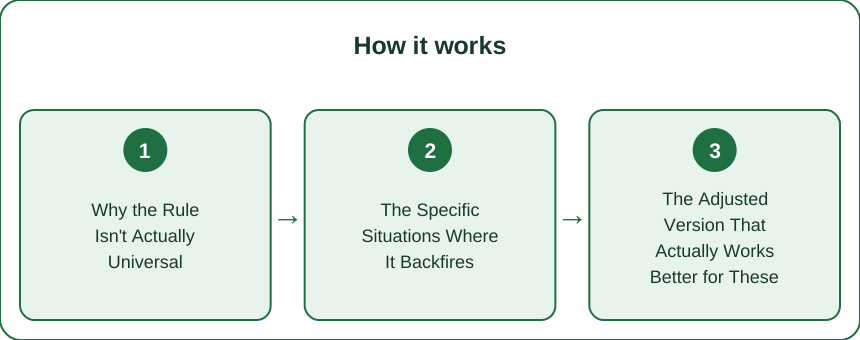
The Adjusted Version That Actually Works Better for These Cases
A more flexible approach: the build-three-to-four-formulas-instead-of-one (the maintaining a small set of go-to formulas for different contexts — professional, casual, social — rather than forcing one formula to cover everything, from the wardrobe-basics-go-with-everything logic — the multiple-formulas-covers-real-variability-without-losing-the-simplicity-benefit), the the-treat-formulas-as-a-starting-point-not-a-fixed-rule (the using a formula as a fast default for low-energy days while still allowing full outfit exploration on days that call for it — the a-flexible-default-beats-a-rigid-rule), the the-build-in-a-seasonal-refresh-checkpoint (the revisiting and adjusting formulas at each seasonal wardrobe transition rather than treating them as permanently fixed, echoing the transition-summer-to-fall-wardrobe logic — the refresh-the-formula-dont-just-repeat-it-forever), the the-let-personality-type-decide-how-much-structure-to-use (the someone who finds decisions fatiguing leaning harder into formula repetition, while someone who enjoys the process keeping more built-in variety — matching the tool to the actual person rather than a one-size rule — the match-the-amount-of-structure-to-your-own-personality), the the-keep-one-flex-piece-in-every-formula (the building one swappable element — an accessory, a layer, a shoe — into each formula specifically to prevent the exact-repetition problem in tight social circles — the a-single-flex-slot-solves-the-repetition-perception-problem), and the frame (the adjusted approach as multiple context-specific formulas rather than one, using formulas as flexible defaults rather than fixed rules, refreshing them seasonally, matching the amount of structure to your own personality, and keeping one flex slot per formula — the underlying idea of the rule survives, just adapted to fit lifestyles the original one-size version never actually served).
The 90 percent outfit rule works well for a specific lifestyle and personality — stable daily context, low craving for outfit variety, and a genuine sense of relief from fewer decisions — but backfires for people with highly variable professional or social schedules, people who use outfit choice as a real mood or energy tool, and tight social circles where visible repetition reads as stuck rather than signature style. Forcing a genuinely poor-fit lifestyle into a single repeated formula tends to create a new kind of friction, the opposite of the rule’s intended benefit, and a rigid formula has no built-in flexibility for seasonal or body changes. The more workable version keeps three or four context-specific formulas instead of one, treats any formula as a flexible fast default rather than a fixed rule, builds in a seasonal refresh checkpoint instead of treating formulas as permanent, matches the amount of structure to your own personality rather than forcing decision-reduction on someone who enjoys the process, and keeps one swappable flex element in each formula to avoid the exact-repetition problem. The underlying idea survives — it just needs to flex.
Keep Reading
This article is for general informational purposes only and is not medical advice. It is not a substitute for professional diagnosis or treatment. Always consult a qualified healthcare provider about your individual situation, especially before making significant changes to your diet or exercise routine.